LORBRENA can cause serious side effects, including:
- Liver problems due to interactions with other medicines.
Liver problems can be severe. It is important to know what medicines not to take during treatment
with LORBRENA.
- Central nervous system (CNS) effects.
CNS effects can be severe. Tell your healthcare provider if you get any new or worsening symptoms of
CNS effects, including: problems with thinking, such as forgetfulness or confusion, changes in mood,
such as depression and thoughts about suicide or dying, psychotic effects, such as seeing or hearing
things that are not real (hallucinations), seizures, changes in speech, and changes in sleep.
- Increases in the cholesterol and triglycerides (lipid) levels in your
blood.
Most people will get an increase in the lipid levels in their blood during treatment with LORBRENA.
-
If you get increases in the lipid levels in your blood, your healthcare provider may start
you on a new medicine or increase your dose if you are already taking a medicine to lower
the lipid levels in your blood.
-
Your healthcare provider will do blood tests to check the lipid levels in your blood before
starting treatment, 1 and 2 months after starting treatment, and during treatment with
LORBRENA.
- Heart problems. LORBRENA can cause very slow or abnormal heartbeats.
Your healthcare provider will check your heart rhythm (electrocardiogram or EKG) before starting and
during treatment with LORBRENA. In some people, these problems are severe, and you may need to get a
pacemaker. Tell your healthcare provider right away if you feel dizzy or faint or have abnormal
heartbeats.
- Lung problems. LORBRENA can cause severe or life-threatening swelling
(inflammation) of the lungs during treatment that can lead to death. Symptoms may be like those from
lung cancer. Tell your healthcare provider right away if you get any new or worsening symptoms of
lung problems, including trouble breathing, shortness of breath, cough, or fever.
- High blood pressure (hypertension). Your healthcare provider will check
your blood pressure before starting treatment, 2 weeks after starting treatment, and then at least
every month during treatment with LORBRENA. Your healthcare provider may start or change your blood
pressure medicine if you get high blood pressure. Tell your healthcare provider right away if you
get signs or symptoms of high blood pressure, including headaches, dizziness, blurred vision, chest
pain, or shortness of breath.
- High blood sugar (hyperglycemia). LORBRENA can cause new or worsening
increases in your blood sugar levels. Your healthcare provider will do blood tests to check your
blood sugar levels before starting and during treatment with LORBRENA. Your healthcare provider may
start or change your blood sugar medicine if you get high blood sugar. Tell your healthcare provider
right away if you get any signs and symptoms of high blood sugar, including: feeling very thirsty,
needing to urinate more than usual, feeling very hungry, feeling sick to your stomach, feeling weak
or tired, and feeling confused.
If you get serious side effects during treatment, your healthcare provider may change your dose,
temporarily stop, or permanently stop treatment with LORBRENA.
Before taking LORBRENA, tell your healthcare provider about all of your medical conditions, including if
you:
- have kidney problems
- have liver problems
- have had episodes of depression or seizures
- have high levels of cholesterol or triglycerides in your blood
- have problems with your heartbeat
- have lung or breathing problems
- have high blood pressure
- have diabetes or high blood sugar
- are pregnant or plan to become pregnant. LORBRENA can harm your unborn baby.
- Females who are able to become pregnant:
- Your healthcare provider will do a pregnancy test before you start treatment with
LORBRENA.
-
Tell your healthcare provider right away if you become pregnant or think you may be pregnant
during treatment with LORBRENA.
-
Use effective non-hormonal birth control during treatment and for at least 6 months after
the final dose of LORBRENA.
-
Birth control pills (oral contraceptives) and other hormonal forms of birth control may not
be effective if used during treatment with LORBRENA. Talk to your healthcare provider about
birth control choices that are right for you during this time.
- Males with female partners who are able to become pregnant:
- Use effective birth control during treatment and for at least 3 months after the
final dose of LORBRENA.
-
are breastfeeding or plan to breastfeed. It is not known if LORBRENA passes into your breast milk.
Do not breastfeed during treatment and for 7 days after the final dose of LORBRENA. Talk to your
healthcare provider about the best way to feed your baby during this time.
Tell your healthcare provider about all the medicines you take, including
prescription medicines, over-the-counter medicines, vitamins, and herbal supplements. Taking LORBRENA
with certain other medicines may increase your risk of side effects and may affect the way LORBRENA or
the other medicines work.
Know the medicines you take. Keep a list of them to show to your healthcare provider and pharmacist when
you get a new medicine.
Do not take LORBRENA if you take certain other medicines called strong
CYP3A inducers. Ask your healthcare provider for a list of these medicines if you are not sure.
The most common side effects of LORBRENA include:
- swelling in your arms, legs, hands, and feet (edema)
- numbness and tingling feeling in your joints or arms and legs (peripheral neuropathy)
- weight gain
- problems with thinking, such as forgetfulness or confusion
- tiredness (fatigue)
- difficulty breathing
- pain in your joints
- diarrhea
- changes in mood, such as depression and irritability
- increased cholesterol and triglyceride levels in the blood
- cough
LORBRENA may cause decreased fertility in males, which may affect your ability to have children. Talk to
your healthcare
provider if you have concerns about fertility.
These are not all of the possible side effects of LORBRENA.
Call your doctor for medical advice about side effects. You may report side effects to the FDA at
1-800-FDA-1088.
What is LORBRENA?
Indication
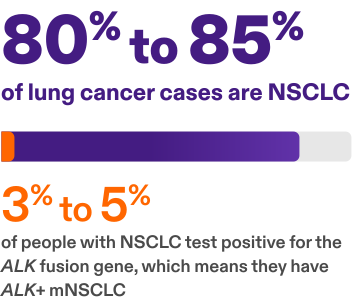
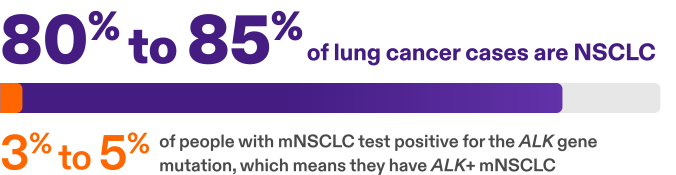
LORBRENA is a prescription medicine that is used to treat adults with non-small cell lung cancer (NSCLC)
that is caused
by an abnormal anaplastic lymphoma kinase (ALK) gene, and that has spread to other
parts of your body (metastatic).
Your healthcare provider will perform a test to make sure that LORBRENA is right for you.
It is not known if LORBRENA is safe and effective in children.
Please see
Full Prescribing
Information
and
Patient
Information.